
 Shop online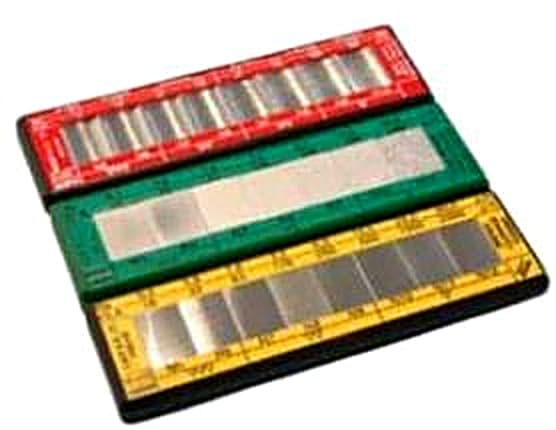
The Rubert 100 Series Heavy Duty Surface Roughness Comparator is a tactile and visual reference set used to estimate the surface roughness of a machined part by direct comparison. Each comparator holds between 5 and 8 specimens mounted in a tough nylon frame and protected by a leather wallet, built for workshop and shop floor use. The specimens are metal surfaces produced by a single machining process, with roughness values ranging from the roughest to the smoothest normally obtained by that process.
Knowing the roughness of a surface matters before any accurate stylus measurement is taken, because the estimate guides the correct cutoff value as specified in BS EN ISO 4288. The set also gives the machinist a working reference during the cutting of a part whose roughness has been called out on the drawing. The method is straightforward: run a fingernail over the work piece and then over the specimens, and estimate the value by comparison. Each label states the nominal Ra value in both microns and micro-inches.
The series spans the common machining methods, from surface and cylindrical grinding (Item 115, 0.025 to 3.2 micrometres Ra) through turning, milling, lapping, honing, polishing and grit or shot blasting, with Ra coverage up to 50.0 micrometres on the turning and casting sets. The comparators can be used in accordance with BS 2634, ISO 2632 and SME (formerly ANSI) B46.1. Supplied by BAMR, South Africa's authorised distributor.
Rubert 100 Series Heavy Duty Surface Roughness Comparator
These comparators are intended for heavy duty use in workshop or shop floor environments. Each one consists of between 5 and 8 specimens mounted in a tough nylon frame and protected by a leather wallet. The specimens in each comparator are metal surfaces produced by the same machining process, but with roughness values ranging from the roughest to the smoothest normally obtained by that process.
- Heavy duty construction Specimens mounted in tough nylon frame and protected by a leather wallet
- Standards compliant Can be used in accordance with BS 2634, ISO 2632, and SME (formerly ANSI) B46.1
- Easy to use Run a fingernail over your work piece and then over the specimens to estimate roughness by comparison
- Pre-machining guidance Provides valuable guidelines and references which can be consulted during the machining of a part whose roughness has been specified on the drawing
- Accurate measurement preparation Select a cutoff value prior to accurate measurement by a stylus instrument as specified in BS EN ISO 4288
When to use the Rubert 100 Series Comparator
On the shop floor you often need to judge whether a machined surface meets a roughness called out on the drawing, and to do it at the machine without setting up a stylus instrument. The Rubert 100 Series gives you specimens produced by the same process as your work piece, so you compare like with like across a single machining method.
- 1Process-matched specimensEach comparator holds 5 to 8 specimens made by one process, such as surface grinding, turning or grit blasting, so you compare your part against a surface made the same way rather than an unrelated reference.
- 2Built for the shop floorSpecimens mounted in a tough nylon frame and protected by a leather wallet survive daily handling at the machine rather than needing the care of a lab.
- 3Guides machining and sets up measurementYou can consult it while machining a part with a specified roughness, and use it to pick a cutoff value before an accurate stylus measurement to BS EN ISO 4288.
- 4Recognised standardsIt can be used in accordance with BS 2634, ISO 2632 and SME (formerly ANSI) B46.1, which matters when a customer or auditor expects a referenced method.
Lower-budget alternatives
Ten minutes on a call with one of our specialists usually saves you from buying the wrong instrument.
Book a 10-minute callOr , our product assistant, for an instant answer.
When to use this
When to use the Rubert 100 Series Comparator
On the shop floor you often need to judge whether a machined surface meets a roughness called out on the drawing, and to do it at the machine without setting up a stylus instrument. The Rubert 100 Series gives you specimens produced by the same process as your work piece, so you compare like with like across a single machining method.
- 1Process-matched specimensEach comparator holds 5 to 8 specimens made by one process, such as surface grinding, turning or grit blasting, so you compare your part against a surface made the same way rather than an unrelated reference.
- 2Built for the shop floorSpecimens mounted in a tough nylon frame and protected by a leather wallet survive daily handling at the machine rather than needing the care of a lab.
- 3Guides machining and sets up measurementYou can consult it while machining a part with a specified roughness, and use it to pick a cutoff value before an accurate stylus measurement to BS EN ISO 4288.
- 4Recognised standardsIt can be used in accordance with BS 2634, ISO 2632 and SME (formerly ANSI) B46.1, which matters when a customer or auditor expects a referenced method.
Lower-budget alternatives
Ten minutes on a call with one of our specialists usually saves you from buying the wrong instrument.
Book a 10-minute callOr , our product assistant, for an instant answer.
Specifications
Range of Roughness Values
| Item No | Machining Method | No of Patches | Ra (µm) | N-Groups |
|---|---|---|---|---|
| 115 | Surface Grinding | 8 | 0.025 to 3.2 | 1 to 8 |
| 116 | Cylindrical grinding | 8 | 0.025 to 3.2 | 1 to 8 |
| 117 | Flat Lapping | 4 | 0.025 to 0.2 | 1 to 4 |
| Criss-cross / parallel | 4 | 0.025 to 0.2 | 1 to 4 | |
| 118 | Cylindrical lapping + superfinishing | 8 (4+4) | 0.025 to 0.2 | 1 to 4 |
| 119 | Face turning | 8 | 0.4 to 50.0 | 5 to 12 |
| 120 | Cylindrical turning | 8 | 0.4 to 50.0 | 5 to 12 |
| 121 | End Milling | 8 | 0.4 to 50.0 | 5 to 12 |
| 122 | Reaming and drilling | 8 (4+4) | 0.4 to 3.2 1.6 to 12.5 | 5 to 8 7 to 10 |
| 123 | Horizontal Milling | 7 | 0.8 to 50.0 | 6 to 12 |
| 125 | Shaping (planning) | 7 | 0.8 to 50.0 | 6 to 12 |
| 126 | linishing (belt sanding) | 6 | 0.1 to 3.2 | 3 to 8 |
| 128 | Vertical grinding | 6 | 0.2 to 6.4 | 4 to 9 |
| 129 | Grit blasting (angular particles) | 6 | 0.4 to 12.5 | 5 to 10 |
| 58 | Shot blasting (spherical particles) | 6 | 0.4 to 12.5 | 5 to 10 |
| 131 | Spark erosion (EDM) | 7 | 0.4 to 25.0 | 5 to 11 |
| 133 | Hand filing | 5 | 0.4 to 6.4 | 5 to 9 |
| 134 | Castings | 7 | 0.8 to 50.0 | 6 to 12 |
| 135 | Honing | 6 | 0.05 to 1.6 | 2 to 7 |
| 136 | Polishing | 5 | 0.0125 to 0.2 | 0 to 4 |
- Item No 115
- Surface Grinding, 8 patches, Ra (µm) 0.025 to 3.2, N-Groups 1 to 8
- Item No 116
- Cylindrical grinding, 8 patches, Ra (µm) 0.025 to 3.2, N-Groups 1 to 8
- Item No 117
- Flat Lapping, 4 patches, Ra (µm) 0.025 to 0.2, N-Groups 1 to 4
- Item No 118
- Cylindrical lapping + superfinishing, 8 patches (4+4), Ra (µm) 0.025 to 0.2, N-Groups 1 to 4
- Item No 119
- Face turning, 8 patches, Ra (µm) 0.4 to 50.0, N-Groups 5 to 12
- Item No 120
- Cylindrical turning, 8 patches, Ra (µm) 0.4 to 50.0, N-Groups 5 to 12
- Item No 121
- End Milling, 8 patches, Ra (µm) 0.4 to 50.0, N-Groups 5 to 12
- Item No 122
- Reaming and drilling, 8 patches (4+4), Ra (µm) 0.4 to 3.2 and 1.6 to 12.5, N-Groups 5 to 8 and 7 to 10
- Item No 123
- Horizontal Milling, 7 patches, Ra (µm) 0.8 to 50.0, N-Groups 6 to 12
- Item No 125
- Shaping (planning), 7 patches, Ra (µm) 0.8 to 50.0, N-Groups 6 to 12
- Item No 126
- Linishing (belt sanding), 6 patches, Ra (µm) 0.1 to 3.2, N-Groups 3 to 8
- Item No 128
- Vertical grinding, 6 patches, Ra (µm) 0.2 to 6.4, N-Groups 4 to 9
- Item No 129
- Grit blasting (angular particles), 6 patches, Ra (µm) 0.4 to 12.5, N-Groups 5 to 10
- Item No 58
- Shot blasting (spherical particles), 6 patches, Ra (µm) 0.4 to 12.5, N-Groups 5 to 10
- Item No 131
- Spark erosion (EDM), 7 patches, Ra (µm) 0.4 to 25.0, N-Groups 5 to 11
- Item No 133
- Hand filing, 5 patches, Ra (µm) 0.4 to 6.4, N-Groups 5 to 9
- Item No 134
- Castings, 7 patches, Ra (µm) 0.8 to 50.0, N-Groups 6 to 12
- Item No 135
- Honing, 6 patches, Ra (µm) 0.05 to 1.6, N-Groups 2 to 7
- Item No 136
- Polishing, 5 patches, Ra (µm) 0.0125 to 0.2, N-Groups 0 to 4
Standards
Standards
Downloads
Frequently asked questions
What is the Rubert 100 Series comparator used for?
It allows estimation of surface roughness by comparing a machined test surface against reference specimens produced by the same machining process. Each comparator covers a specific machining method.
How are the comparators constructed?
Each comparator consists of between 5 and 8 reference specimens mounted in a tough nylon frame and protected by a leather wallet, intended for workshop or shop floor use.
Which machining processes are covered in the range?
The range covers surface grinding, cylindrical grinding, flat lapping, cylindrical lapping and superfinishing, face turning, cylindrical turning, end milling, reaming and drilling, horizontal milling, shaping, linishing, vertical grinding, grit blasting, shot blasting, spark erosion, hand filing, castings, honing, and polishing.
What roughness range is available for grit blasting versus polishing?
The grit blasting comparator (item 129) covers Ra 0.4 to 12.5 micrometres across 6 patches. The polishing comparator (item 136) covers Ra 0.0125 to 0.2 micrometres across 5 patches.

Quote on the Rubert 100 Series Heavy Duty Surface Roughness Comparator by close of business.
Tell us about your application and we will send a quote with lead time and accessories.
Not sure this is the right model for your job? for a quick recommendation.
Request a quote
Request a quote
Tell us about your application and we will send a quote with lead time and accessories.