
 Shop online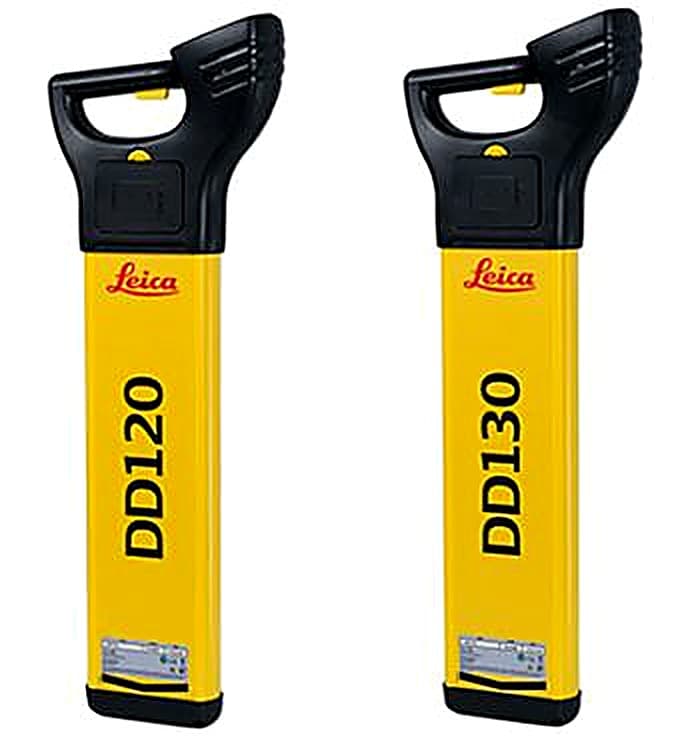
The Leica DD120 and DD130 Pipe and Cable Locators (part numbers DD120 and DD130) detect the position of buried cables and pipes before excavation. Striking an unknown underground service during digging risks operator injury, damage to the asset and the costs that follow, so locating utilities first is a core safety step on construction sites.
Both locators offer power, radio and auto modes and automatic pinpointing, with a paired transmitter applying a traceable signal at 33kHz or 8kHz to lines that may not otherwise carry a detectable signal. They accept power at 50Hz or 60Hz, detect radio in the 15kHz to 60kHz band, and include a Good-to-Go health check and start-up test. Each unit is IP54 rated for protection from dust and water, operates from -20 degrees C to +50 degrees C, runs on 6 x LR6 (AA) alkaline batteries for around 15 hours, and weighs 2.7kg with batteries. Depth accuracy is 10 percent.
The two models differ in trace range and depth. The DD120 transmits at 33kHz and 8kHz with line and sonde depth detection from 0.3m to 3m. The DD130 adds 512Hz and 640Hz frequencies for extended tracing and increases sonde detection up to 9.99m, while signal current measurement helps confirm the right line is being followed. Both are supplied by BAMR, South Africa's authorised distributor.
Leica DD120 & DD130 Pipe & Cable Locators
Avoiding underground cables and pipes is a major concern on construction sites. Therefore, detecting the position of buried cables and pipes before excavation work can help prevent operator injury, asset damage risks and any subsequent costs.
- Automatic pinpointing
- Power, radio, auto modes
- Transmitter, 33 kHz, 8 kHz
- Depth detection up to 3 metres
- Good-to-Go™ health check and start up test
- IP54 rating protection from dust and water
- Extended trace range with additional 512 Hz, 640 Hz frequencies
- Signal current measurement
- Increased depth detection up to 10 m
BAMR no longer supplies this product.
When to use the Leica DD120 & DD130 Locators
Use the Leica DD120 or DD130 to locate buried cables and pipes before excavation on a construction site. Detecting underground services before breaking ground helps prevent operator injury, asset damage and the costs that follow a strike.
- 1Find services before diggingDetecting buried cables and pipes before excavation is the core reason to scan a site, reducing the risk of operator injury and damage to underground assets.
- 2Multiple modes and frequenciesPower, radio and auto modes, with transmitter frequencies of 33 kHz and 8 kHz and extended 512 Hz and 640 Hz trace frequencies, let you trace different service types rather than relying on a single signal.
- 3Automatic pinpointing with depthAutomatic pinpointing plus depth detection (up to 3m, and up to 10m with increased detection) tells you where a service is and how deep it sits, so you can plan the dig with that information in hand.
- 4Rated for the siteAn IP54 rating gives protection from dust and water, and the Good-to-Go health check and start up test confirm the unit is working before you rely on it outdoors.
Lower-budget alternatives
Ten minutes on a call with one of our specialists usually saves you from buying the wrong instrument.
Book a 10-minute callOr , our product assistant, for an instant answer.
When to use this
When to use the Leica DD120 & DD130 Locators
Use the Leica DD120 or DD130 to locate buried cables and pipes before excavation on a construction site. Detecting underground services before breaking ground helps prevent operator injury, asset damage and the costs that follow a strike.
- 1Find services before diggingDetecting buried cables and pipes before excavation is the core reason to scan a site, reducing the risk of operator injury and damage to underground assets.
- 2Multiple modes and frequenciesPower, radio and auto modes, with transmitter frequencies of 33 kHz and 8 kHz and extended 512 Hz and 640 Hz trace frequencies, let you trace different service types rather than relying on a single signal.
- 3Automatic pinpointing with depthAutomatic pinpointing plus depth detection (up to 3m, and up to 10m with increased detection) tells you where a service is and how deep it sits, so you can plan the dig with that information in hand.
- 4Rated for the siteAn IP54 rating gives protection from dust and water, and the Good-to-Go health check and start up test confirm the unit is working before you rely on it outdoors.
Lower-budget alternatives
Ten minutes on a call with one of our specialists usually saves you from buying the wrong instrument.
Book a 10-minute callOr , our product assistant, for an instant answer.
Specifications
Specifications
| Specification | DD120 | DD130 |
|---|---|---|
| Power | 50Hz model or 60Hz model | 50Hz model or 60Hz model |
| Radio | 15kHz to 60kHz | 15kHz to 60kHz |
| Auto | Power, Radio, 33kHz | Power, Radio, 33kHz |
| Transmitter Modes | 32.768 (33) kHz, 8.192 (8) kHz | 32.768 (33) kHz & 8.192 (8) kHz, 512 Hz & 640 Hz |
| Depth Range | Line 0.3m to 3m, Sonde 0.3m to 3m | Line 0.3m to 3m, Sonde 0.3m to 9.99m |
| Depth Accuracy | 10% | 10% |
| Environmental Standard | IP54 | IP54 |
| Operating Temperature | -20°C to +50°C | -20°C to +50°C |
| Battery | 6 x LR6 (AA) Alkaline | 6 x LR6 (AA) Alkaline |
| Battery operating time | 15h | 15h |
| Dimensions (HxWxD) | 760 x 250 x 85mm | 760 x 250 x 85mm |
| Weight with batteries | 2.7kg | 2.7kg |
Accessories
Accessories
| Mini Sonde 33, 18mm diameter 33kHz Sonde used to trace drains, sewers and other non-conductive utilities. Mini Sonde has a M12 female thread and can be attached to a range of equipment including drain rods, boring tools and inspection cameras. Powered by 1 x 3.6v battery, with a depth range of 10 meters |
| Midi Sonde 8/33, 38mm diameter dual frequency 8kHz or 33kHz Sonde used to trace drains, sewers and other non conductive utilities. Midi Sonde has a M10 male thread with an additional female adapter and can be attached to a range of equipment including drain rods, boring tools and inspection cameras. Powered by 1 x AA alkaline battery, with a working depth range of 5 meters |
| Maxi Sonde 8/33, 55mm diameter dual frequency 8kHz or 33kHz Sonde used to trace deep lying drains, sewers and other non conductive utilities. Maxi Sonde has a M10 male thread with an additional female adapter and can be attached to a range of equipment including drain rods, boring tools, and inspection cameras. Powered by 3 x AA alkaline batteries, with a depth range of 12 meters |
| Clamp Sonde 33, 40mm 33kHz Sonde. Clamps directly on to 12mm duct rod or the cable of a sewer inspection camera. Used to trace the route of the duct, position of the inspection camera or a blockage. Powered by 1 x AAA battery. with a working depth range of 5 meters |
| DA220 Signal Transmitter |
Downloads
Frequently asked questions
What is the depth range for locating buried lines with the DD120 and DD130?
Both models locate lines from 0.3 m to 3 m depth. The DD130 extends sonde depth detection to 9.99 m, compared to 3 m on the DD120. Depth accuracy is 10% for both.
What frequency modes are available on each model?
Both models support Power, Radio, and 33 kHz Auto modes, plus 32.768 kHz and 8.192 kHz transmitter modes. The DD130 adds 512 Hz and 640 Hz transmitter modes.
What is the environmental rating and battery life?
Both units are rated IP54 and operate from minus 20 to plus 50 degrees Celsius. They run on 6 x AA alkaline batteries with a 15-hour battery operating time.

Ask about the Leica DD120 & DD130 Pipe & Cable Locators and its alternatives.
Tell us about your application and we will send a quote with lead time and accessories.
Not sure this is the right model for your job? for a quick recommendation.
Check availability
Ask about availability
Tell us about your application and we will confirm remaining stock or recommend a current alternative.