
 Shop online
How to Choose the Right Elcometer 456 Model
The Elcometer 456 isn't a single product, it's a range spanning three functionality tiers and two probe configurations, so the right choice depends on what you're measuring, how often, and what you need to do with the data afterwards.
In this article
If you're specifying a coating thickness gauge, the Elcometer 456 range is one of the most established options on the market, but "Elcometer 456" isn't a single product. It's a range spanning three functionality tiers and two probe configurations, so the right choice depends on what you're measuring, how often, and what you need to do with the data afterwards. Here's how to work through it.
Step 1: Basic, Standard, or Top?
The Elcometer 456 is available in three models, each adding functionality on top of the last:
| Feature | Basic | Standard | Top |
|---|---|---|---|
| Fast reading rate (>60 readings/min) | Yes | Yes | Yes |
| Auto substrate recognition (FNF models) | Yes | Yes | Yes |
| Switchable metric/imperial units | Yes | Yes | Yes |
| Backlight display | Yes | Yes | Yes |
| Data memory / storage | No | Yes | Yes |
| Bluetooth wireless data transfer | No | Yes | Yes |
| USB connection + ElcoMaster software | No | Yes | Yes |
| Transit case included | No | No | Yes |
Choose Basic if you just need fast, accurate spot-checks with no record-keeping requirement, think quick QC checks on the shop floor where a pass/fail reading is all you need.
Choose Standard if you need to keep a record of your readings, for compliance, audits, or client reports, and want to pull that data into ElcoMaster for a PDF or Excel report without writing anything down by hand.
Choose Top if you're doing this professionally and regularly in the field: it adds a transit case for site work, on top of everything Standard offers.
Step 2: Integral or separate probe?
This is the second decision, independent of the model tier:
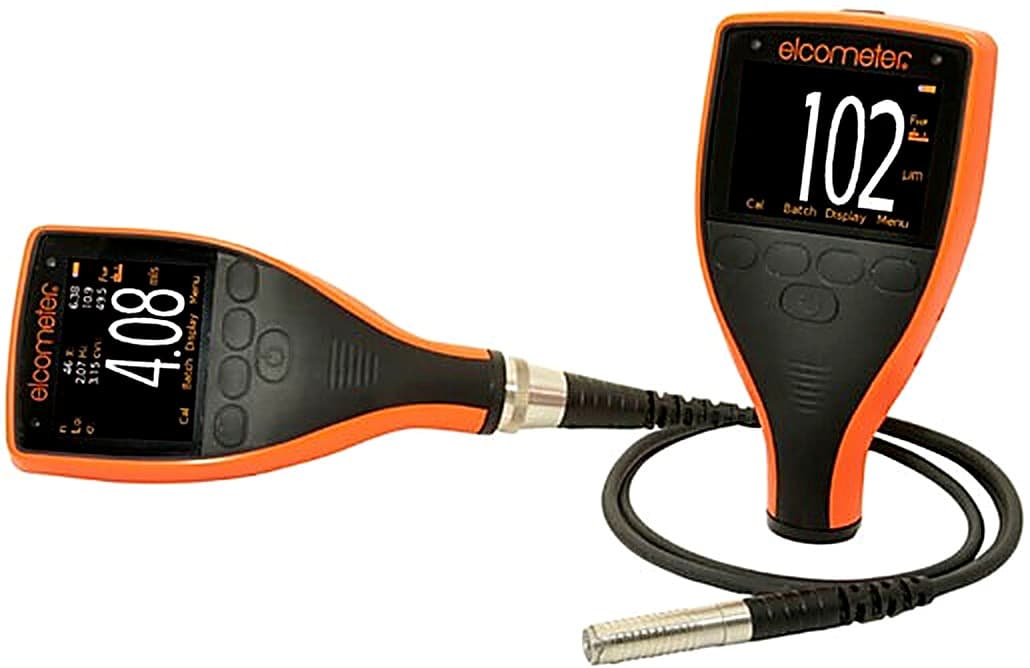
Integral probe - the probe is built into the gauge body. Simpler, more compact, ideal for single-handed operation on accessible flat surfaces.
Separate probe - the probe connects via cable and can be swapped out. This is the right call if you're measuring in tight or awkward spaces, need different probe types for different substrates, or expect your measurement needs to change over time.
If you're only ever measuring one type of surface in easy-to-reach locations, integral keeps things simple. If your work varies, different substrates, hard-to-reach areas, or you want flexibility to add probes later, separate is worth the extra setup.
Step 3: Ferrous, non-ferrous, or dual (FNF)?
The 456 also comes in substrate-specific versions:
- Ferrous (F) - for coatings on steel and other magnetic metals
- Non-ferrous (NF) - for coatings on aluminium, copper, and other non-magnetic metals
- Dual (FNF) - automatically detects and measures on both, switching substrate type without manual reconfiguration
If you work across mixed-metal environments, common in industrial coating inspection, the FNF version saves you from carrying two gauges or manually switching modes mid-job.
Quick decision guide
- Occasional spot-checks, no reporting needed: Basic, integral
- Regular inspections with reporting or compliance requirements: Standard, integral or separate depending on surface access
- Daily field use across varied sites and substrates: Top, separate probe, FNF
Not sure which combination fits your application?
Every job is a little different, substrate, coating type, environment, and reporting requirements all factor in. BAMR has been the authorised Elcometer distributor across South Africa and Sub-Saharan Africa for 80 years. Get in touch with our team for advice on the right configuration, or browse the full Elcometer 456 range on gaugeit.co.za.
Got a question about this, or need help picking the right instrument for your job? , our product assistant.
Instruments referenced above.
Technical specialist at BAMR. Has spent years advising coating inspectors at industrial sites across southern Africa on instrument selection and compliance requirements.
More articles →
Need help choosing the right instrument?
Talk to a BAMR specialist about your application.
In a hurry? , our product assistant.