
 Shop online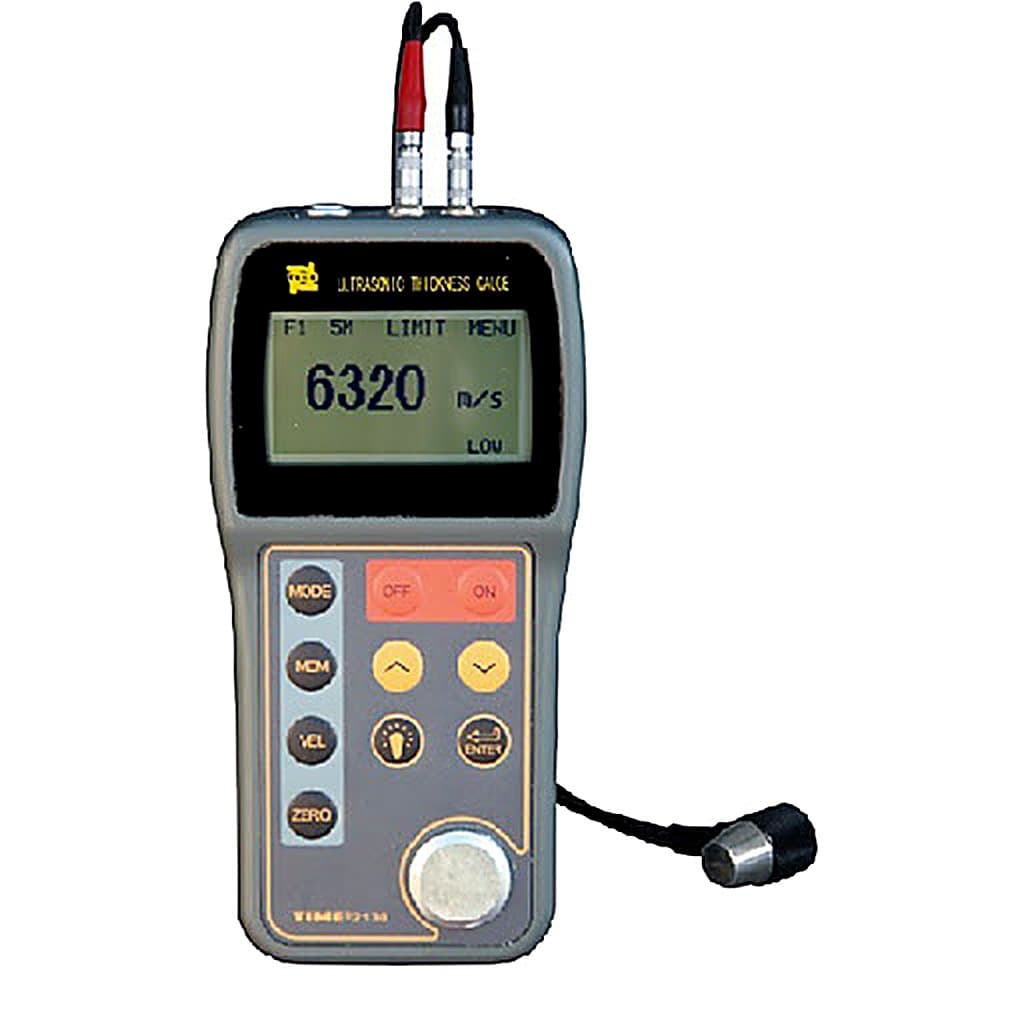
The TT2130 Ultrasonic Wall Thickness and Material Thickness Gauge (previously the TT300) is a handheld, microprocessor-controlled gauge for measuring the thickness of metallic and non-metallic materials, including aluminium, titanium, plastics, ceramics, glass and cast iron, provided the material conducts ultrasound well and has parallel top and bottom surfaces. Its core use is non-destructive measurement from one side only, which lets you check raw materials, component parts and assembled machinery without cutting into them, and monitor pipes and pressure vessels for wall loss caused by corrosion before it becomes a failure.
The TT2130 Ultrasonic Wall Thickness works by timing an ultrasonic pulse through the material and converting that into a thickness reading. With a 5MHz transducer it measures 1.2mm to 225.0mm, and with a 2MHz transducer 5.0mm to 300.0mm. Display resolution of the TT2130 Ultrasonic Wall Thickness is selectable at 0.1mm or 0.01mm, with a measuring accuracy of plus or minus 1% of thickness plus 0.1mm. Sound velocity is user-programmable, either by calibrating against a known standard or by setting the velocity from a speed-of-sound chart, and two-point calibration improves accuracy. The TT2130 Ultrasonic Wall Thickness stores up to 500 readings with RS232 output to a PC or printer, runs on two AA 1.5V batteries for around 100 hours without backlight, weighs 370g and operates from -10 to 60 degrees C.
Used across NDT, corrosion monitoring and quality control in refineries, marine and general engineering, the TT2130 Ultrasonic Wall Thickness is supplied by BAMR, South Africa's authorised distributor.
TT2130 Ultrasonic Wall Thickness; Material Thickness Gauge (previously TT300)
The new TT2130 Ultrasonic Wall Thickness; Material Thickness Gauge (previously TT300) is a handheld microprocessor-controlled thickness gauge, specifically designed for measuring the thickness of metallic and non-metallic materials eg. aluminium, titanium, plastics, ceramics, glass, cast iron and other good ultrasonic wave-conducting materials, as long as the material has parallel top and bottom surfaces. The TT2130 can perform precise measurements on various types of raw materials, component parts, and assembled machinery. It can also be used to monitor all types of pipes and pressure vessels for loss of thickness due to corrosion. With the TT2130 you can record up to 500 readings and download them to a computer.
When to use the TT2130 thickness gauge
Use the TT2130 when you need to record thickness measurements and download them, not just read them on site. It measures metallic and non-metallic materials with parallel surfaces, including aluminium, titanium, plastics, ceramics, glass and cast iron, and monitors pipes and pressure vessels for corrosion loss. It stores up to 500 readings and outputs to a printer or PC.
- 1Stores up to 500 readingsLogging up to 500 readings with RS232 output to a printer or PC supports record-keeping and reporting across a survey, not just one-off checks.
- 2Two transducer optionsA 5MHz transducer covers 1.2 to 225.0mm and a 2MHz transducer covers 5.0 to 300.0mm, so you can match the probe to thin or thicker sections.
- 3Wide material and temperature rangeIt reads cast iron alongside other ultrasonic-conducting materials and operates from -10 to 60 degrees C, suiting varied field conditions.
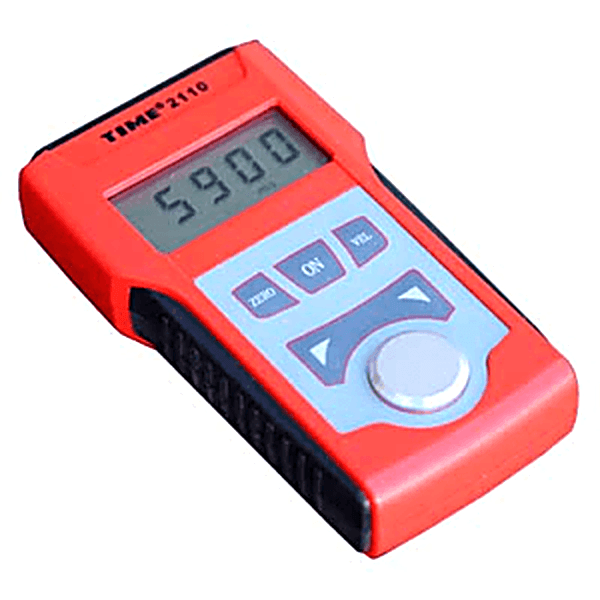
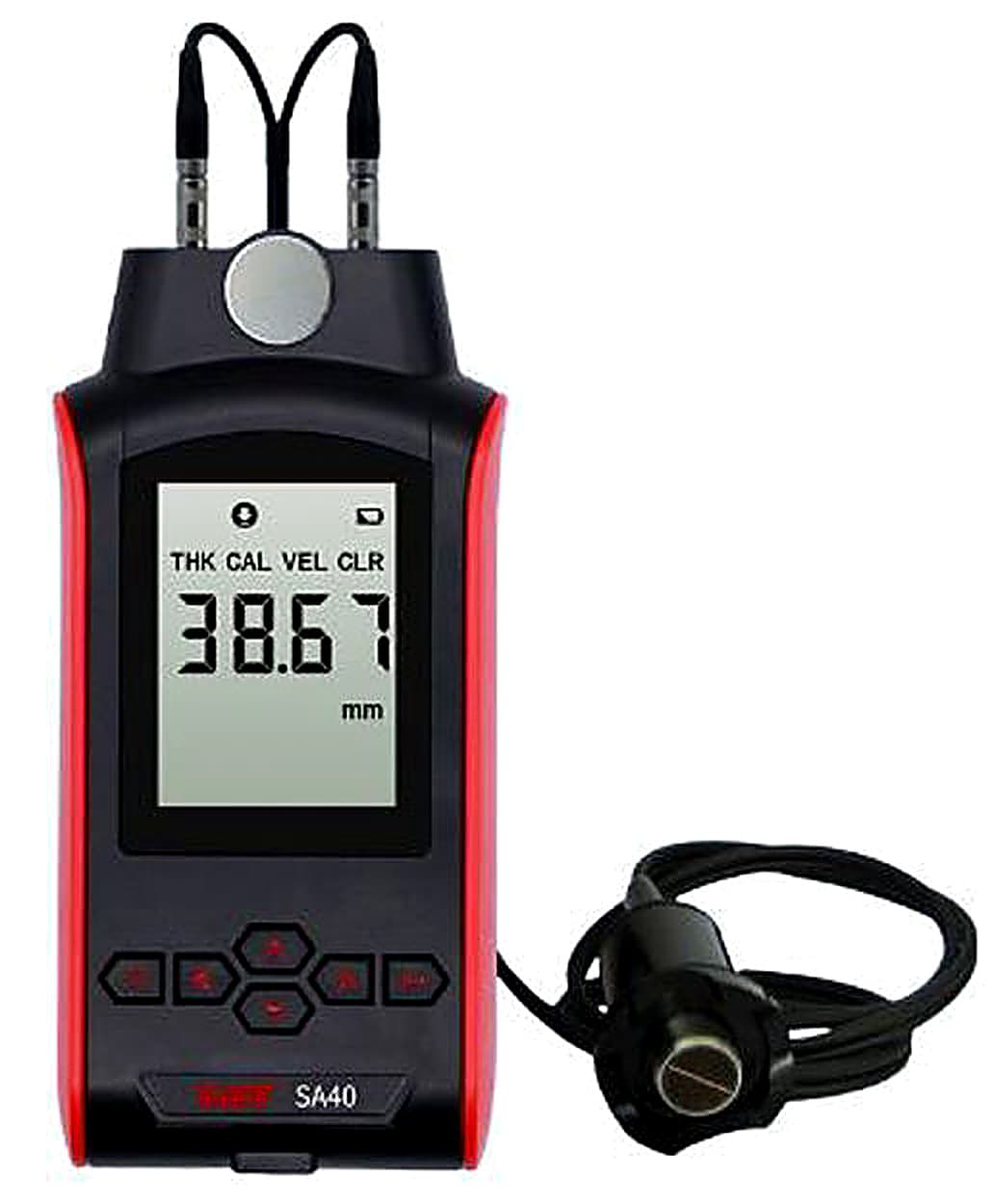
Lower-budget alternatives
Ten minutes on a call with one of our specialists usually saves you from buying the wrong instrument.
Book a 10-minute callOr , our product assistant, for an instant answer.
When to use this
When to use the TT2130 thickness gauge
Use the TT2130 when you need to record thickness measurements and download them, not just read them on site. It measures metallic and non-metallic materials with parallel surfaces, including aluminium, titanium, plastics, ceramics, glass and cast iron, and monitors pipes and pressure vessels for corrosion loss. It stores up to 500 readings and outputs to a printer or PC.
- 1Stores up to 500 readingsLogging up to 500 readings with RS232 output to a printer or PC supports record-keeping and reporting across a survey, not just one-off checks.
- 2Two transducer optionsA 5MHz transducer covers 1.2 to 225.0mm and a 2MHz transducer covers 5.0 to 300.0mm, so you can match the probe to thin or thicker sections.
- 3Wide material and temperature rangeIt reads cast iron alongside other ultrasonic-conducting materials and operates from -10 to 60 degrees C, suiting varied field conditions.
Lower-budget alternatives
Ten minutes on a call with one of our specialists usually saves you from buying the wrong instrument.
Book a 10-minute callOr , our product assistant, for an instant answer.
Specifications
Specifications
- Measuring Range :
- 1.2mm – 225.0mm with 5MHz transducer
- 5.0mm – 300.0mm with 2MHz transducer
- Operating Temperature :
- -10°C to 60°C
- Lower Limit Steel Pipes :
- Dia 20mm x 3.0mm
- Display Resolution :
- 0.1mm / 0.01mm
- Data Output :
- RS232 Output for Printer or PC
- Measuring Accuracy :
- ±1% thickness + 0.1mm
- Sound Velocity :
- 1000m/s – 999 m/s
- Power Supply :
- 2 pcs AA batteries 1.5V
- Battery Life :
- 100 hours without backlight
- Dimensions :
- 152mm x 74mm x 35mm
- Weight :
- 370g
Sound Velocities
Sound Velocities
| Material | m/s | Material | m/s | ||
|---|---|---|---|---|---|
| Metals | |||||
| A | Aluminium | 6 320 - 6 400 | M | Molybdenum | 6 250 - 6 300 |
| Aluminium (2024-T4) | 6 380 | Mercury | 1 450 | ||
| Asbestos Cement | 2 200 | N | Nickel | 5 480 - 6 040 | |
| B | Beryllium | 12 880 | P | Platinum | 3 690 |
| Boron Carbide | 10 920 | S | Silver | 3 600 - 3 700 | |
| Brass | 4 390 | Steel, Mild | 5 900 - 6 100 | ||
| C | Cast Iron | 3 500 - 5 600 | Steel, Casting (4340) | 5 850 | |
| Cast Iron (Modular Graphite) | 5 600 | Steel, 303 Stainless (Austenitic) | 5 660 - 6 120 | ||
| Cast Grey Middle | 4 600 | Stellite | 7 050 | ||
| Copper | 4 650 - 4 720 | T | Tin | 3 300 - 3 330 | |
| Cadmium | 2 770 - 2 800 | Titanium | 5 900 - 6 100 | ||
| Chromium | 6 200 | Tungsten Carbon | 6 650 | ||
| G | Gold | 3 200 - 3 250 | Tungsten | 5 180 - 5 400 | |
| I | Inconel | 5 820 | U | Uranium | 3380 |
| Iron | 5 890 - 5 930 | W | Wolfram | 5 460 | |
| L | Lead | 1 960 - 2 400 | Z | Zinc | 4 170 - 4 320 |
| M | Manganese | 4 660 - 4 700 | Zircaloy 2 | 4 700 | |
| Magnesium | 5 770 - 5 840 | Zirconium | 4 650 | ||
| Non-Metal | |||||
| A | Acrylic | 2 870 | N | Nylon | 2 600 - 2 690 |
| Acrylic Resin | 2 730 - 2 870 | O | Oil (SAE 30) | 1 740 | |
| Air | 330 | P | Paraffin Wax | 2 200 | |
| Aluminium Oxide | 8 700 | Perspex | 2 860 | ||
| C | Ceramic (Macor) | 5 631 | Phenolic | 1 400 | |
| Diamond | 17 500 | Plexi Glass | 2 690 | ||
| Diesel Oil | 1 250 | Polyamide | 2 380 | ||
| Epoxy Resin | 2 650 | Polyethylene | 1 900 - 2 400 | ||
| G | Glass (Flint) | 4 260 | Polyurethane | 1 780 - 1 900 | |
| Glass (Crown) | 5 260 - 6 120 | Polystyrene | 2 340 - 2 400 | ||
| Glass (Quartz) | 5 570 | Porcelain | 5 600 - 5 900 | ||
| Glass (Window) | 6 800 | PVC | 2 400 | ||
| Glycerine | 1 930 | Q | Quartz X Cut | 5 740 | |
| I | Ice | 3 980 | Quartz Fused | 5 980 | |
| H | Hi-Density Polyethelene | 2 220 - 2 300 | Rubber (Butyl) | 1 900 | |
| (Grey & White, Not Black) | R | Rubber (Soft) | 1 480 | ||
| M | Methylene-Oxide | 9 980 | Rubber (Vulc.) | 2 300 | |
| Monel | 5 360 - 5 400 | S | Silicone Rubber | 948 | |
| Motor Oil (SAE 30) | 1 750 | T | Teflon | 1 350 - 1 520 | |
| N | Neoprene | 1 600 | W | Water | 1470 |
- Note
- Please Note : This Schedule is only a Guide
Frequently asked questions
What materials and thickness range does the TT2130 handle?
The TT2130 measures metallic and non-metallic materials including aluminium, titanium, plastics, ceramics, glass, and cast iron, provided surfaces are parallel. Using the 5MHz transducer, the range is 1.2 to 225.0mm.
Can the TT2130 monitor corrosion in pipes and pressure vessels?
Yes. The TT2130 is described as suitable for monitoring all types of pipes and pressure vessels for loss of thickness due to corrosion. The lower limit for steel pipes is 20mm diameter with a 3.0mm wall.
What data logging and output does the TT2130 provide?
The TT2130 stores up to 500 readings and transfers data via RS232 output to a printer or PC. Display resolution is selectable at 0.1mm or 0.01mm.
What is the measurement accuracy of the TT2130?
Accuracy is plus or minus 1% of thickness plus 0.1mm. The sound velocity is user-adjustable so the gauge can be configured for a wide range of materials using the supplied velocity reference chart.
How is the TT2130 powered and what is the battery life?
The TT2130 uses two 1.5V AA batteries. Battery life is 100 hours without backlight. Operating temperature is -10 to 60 degrees C.

Quote on the TT2130 Ultrasonic Wall Thickness; Material Thickness Gauge (previously TT300) by close of business.
Tell us about your application and we will send a quote with lead time and accessories.
Not sure this is the right model for your job? for a quick recommendation.
Request a quote
Request a quote
Tell us about your application and we will send a quote with lead time and accessories.